
Back to Articles
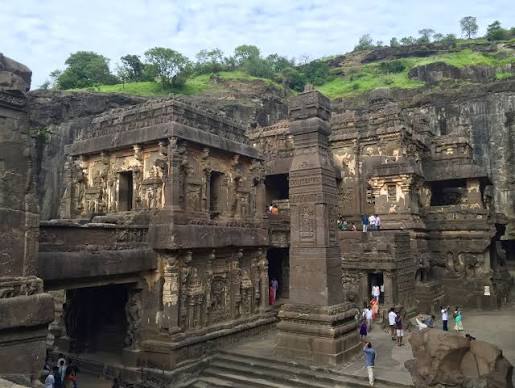
Cave 16 – The Kailasa Temple
A Temple Carved from the Top Down
Removing Enormous Quantities of Rock
Why Was the Temple Carved from the Top?
The Rashtrakuta Dynasty
King Krishna I and Royal Patronage
Dravidian Architectural Influence
Gajalakshmi
The Nandi Mandapa
The Main Shiva Temple
Pillars and Monumental Structures
Independent Shrines
Stories from the Ramayana
Scenes from the Mahabharata
Ravana Shaking Mount Kailasa
Shiva and Parvati
Vishnu as Varaha
Narasimha
Durga and Mahishasura
The Paintings of Kailasa
Engineering Knowledge
A Monumental Team Effort
The Temple as a Sacred Mountain
The Kailasa “Mystery”
How Did the Ancient Workers Plan It?
Kailasa and Indian Sculpture
A Stone Book of Indian Mythology
Religious Diversity at Ellora
Why Kailasa Is Important Today
Engineering
History
Religion
Culture
Conservation of the Monument
Ellora as a World Heritage Site
The Greatest Achievement of Kailasa
What Kailasa Teaches Us
Ellora’s Kailasa Temple
The Magnificent Temple Carved from a Single Rock
Introduction
India’s ancient civilization produced some of the most remarkable achievements in architecture, sculpture, engineering, literature, and religious art. Among these extraordinary monuments, the **Kailasa Temple at Ellora** occupies a special place.
Located in Maharashtra, India, the Kailasa Temple is designated as **Cave 16 of the Ellora Caves**. It is one of the most spectacular rock-cut monuments in the world and is dedicated to **Lord Shiva**.
What makes the temple particularly remarkable is its method of construction. Unlike an ordinary temple, which is constructed by assembling stones, the Kailasa Temple was **excavated and carved directly out of a massive natural basalt rock formation**.
The artisans did not build the temple by adding stone. Instead, they removed enormous quantities of rock until the temple emerged from the mountain itself.
Even more astonishing is the fact that the principal excavation proceeded **from the top downward**.
More than a thousand years ago, without modern drilling machines, cranes, power tools, or construction equipment, generations of skilled artisans transformed a massive piece of hard volcanic rock into an elaborate temple complex filled with pillars, shrines, sculptures, courtyards, and religious narratives.
---
The Ellora Caves
The Kailasa Temple forms part of the extraordinary **Ellora Cave complex**, one of the most important historical and artistic sites in India.
Ellora is located in the Deccan region of Maharashtra, near present-day Aurangabad, now officially known as Chhatrapati Sambhajinagar.
The caves were excavated into a long basalt cliff and developed over several centuries.
The Ellora complex contains monuments associated with three major religious traditions:
* Buddhism
* Hinduism
* Jainism
The principal accessible caves are traditionally numbered from 1 to 34.
The Buddhist caves are generally associated with the earlier phase of development, while the Hindu and Jain monuments were created and expanded during later centuries.
This extraordinary concentration of monuments makes Ellora an important record of India's religious, artistic, and architectural history.
---
Ellora and the Ancient Trade Routes
The location of Ellora was not accidental.
In ancient India, religious establishments and monastic complexes were frequently located near important trade routes. Merchants travelled long distances across the subcontinent, and monasteries could provide places for travelers, monks, ascetics, and pilgrims to rest.
Wealthy merchants frequently supported religious institutions through donations, while rulers sometimes provided royal patronage.
Ellora developed within this broader cultural and commercial environment.
The Deccan was an important region connecting different parts of the Indian subcontinent, and the movement of merchants, religious teachers, craftsmen, and rulers helped spread artistic ideas across the region.
---
Cave 16 – The Kailasa Temple
Among all the monuments at Ellora, **Cave 16**, known as the Kailasa Temple, is by far one of the most impressive.
The temple is dedicated to Lord Shiva and represents **Mount Kailasa**, the sacred Himalayan abode of Shiva in Hindu tradition.
The architects created an entire temple complex from a single massive rock.
Instead of entering a cave carved horizontally into the cliff, visitors encounter what appears to be a freestanding temple surrounded by a large courtyard.
This visual effect is one of the greatest achievements of the monument.
A Temple Carved from the Top Down
The construction technique of the Kailasa Temple is one of its most fascinating features.
Most traditional buildings are constructed from the bottom upward. Foundations are laid first, walls are raised, and the roof or tower is added afterward.
The Kailasa Temple followed a fundamentally different approach.
The artisans began by cutting into the **upper portion of the rock** and gradually worked downward.
Large trenches were excavated around the intended structure, separating the future temple from the surrounding rock.
The unnecessary rock was then removed progressively, leaving behind the portions that would become the temple.
In this way, the temple was effectively **released from the mountain**.
Removing Enormous Quantities of Rock
The scale of the excavation was enormous.
Popular estimates suggest that approximately **200,000 tonnes of rock** may have been removed during the creation of the monument, although exact figures are difficult to establish.
The builders did not have modern machinery.
They worked without:
* Electric drills
* Hydraulic machinery
* Cranes
* Bulldozers
* Modern cutting equipment
* Industrial explosives
Instead, ancient workers relied primarily on metal tools, hammers, chisels, wedges, and enormous amounts of organized human labor.
Removing the rock was only the beginning.
Once the basic mass of the temple had been established, highly skilled sculptors began creating architectural details and religious imagery.
Why Was the Temple Carved from the Top?
The decision to excavate from the top downward may have had important practical advantages.
By beginning at the upper surface, the builders could establish the height and general outline of the temple before moving deeper into the rock.
The process also allowed the artisans to control the amount of material being removed and preserve the structural mass needed for the temple.
However, the precise construction sequence is not fully documented in surviving historical records.
Therefore, while the top-down method is clearly visible in the monument, specific explanations about why every individual construction decision was made should be treated with caution.
The Rashtrakuta Dynasty
The Kailasa Temple is primarily associated with the **Rashtrakuta dynasty**, which became a major political power in the Deccan during the eighth century.
The principal construction of the temple is traditionally attributed to **King Krishna I**, who ruled approximately from 757 to 773 CE.
Some scholars have suggested that work may have begun under his predecessor, **Dantidurga**, while later rulers may have contributed to additional parts of the complex.
This suggests that the Kailasa Temple may have developed in several stages rather than being completed as a single short-term project.
King Krishna I and Royal Patronage
King Krishna I is traditionally regarded as the principal royal patron of the Kailasa Temple.
The creation of such a monumental structure required enormous resources.
A project of this scale would have required:
* Architects
* Engineers and planners
* Stone workers
* Sculptors
* Religious specialists
* Skilled craftsmen
* Laborers
* Supervisors
* Material and labor organization
The monument therefore represents not merely the work of individual artists but the achievement of a large and highly organized society.
Dravidian Architectural Influence
The Kailasa Temple contains strong elements associated with **Dravidian or South Indian temple architecture**.
Its tower, halls, shrines, pillars, and overall composition reflect traditions that had developed in southern India.
The Deccan served as a cultural meeting ground where artistic traditions from different regions interacted.
The architectural character of Kailasa therefore reflects a combination of regional traditions rather than an isolated style.
The Entrance Gateway
The temple complex begins with a monumental entrance.
Beyond the gateway lies a large courtyard containing the main temple and numerous sculptural and architectural elements.
The entrance area is richly decorated with religious imagery.
Different deities appear throughout the complex, reflecting the broad religious world of medieval Hindu art.
One of the notable images associated with the entrance is **Gajalakshmi**, the goddess Lakshmi shown with elephants performing a ritual ablution.
Gajalakshmi
The image of Gajalakshmi is an important example of the temple's refined sculptural tradition.
Lakshmi is shown seated on a lotus, while elephants pour water over her.
The lotus and elephants carry powerful symbolic meanings in Indian religious art, including purity, prosperity, auspiciousness, and abundance.
The presence of such imagery at the entrance also reinforces the sacred character of the temple complex.
The Nandi Mandapa
In Shaiva temples, **Nandi**, the sacred bull and vehicle of Lord Shiva, occupies an important position.
At Kailasa, a separate Nandi pavilion stands in front of the main Shiva temple.
The relationship between the Nandi pavilion and the main shrine is carefully planned.
Nandi faces the principal shrine, creating a visual and ritual connection between the devotee, the sacred bull, and Shiva.
The Nandi structure itself was carved from the same rock mass as the surrounding complex.
The Main Shiva Temple
The central temple is the heart of the Kailasa complex.
It contains the principal shrine dedicated to Lord Shiva.
The main hall is supported by numerous pillars, and the structure includes a sanctum, halls, passageways, and richly decorated exterior surfaces.
The temple appears to stand independently within the courtyard, but it is actually part of the enormous rock from which the entire complex was carved.
This combination of apparent architectural independence and geological unity is one of the most remarkable features of Kailasa.
Pillars and Monumental Structures
The temple contains numerous large pillars and architectural elements.
The pillars are not merely structural supports. Many are decorated with carefully carved details.
Large vertical elements, including monumental columns traditionally associated with flagstaffs, contribute to the dramatic appearance of the complex.
The scale of these structures demonstrates the ability of the artisans to control enormous masses of stone while simultaneously producing delicate sculptural details.
Independent Shrines
The Kailasa complex contains several subsidiary shrines and sacred structures.
Some are associated with important Hindu deities and sacred rivers.
Representations of **Ganga, Yamuna, and Saraswati** are especially significant.
In Indian temple architecture, sacred rivers symbolize purification and spiritual renewal.
Their inclusion within the temple complex reinforces the idea that the temple represents not merely a physical building but a sacred cosmic environment.
Stories from the Ramayana
The Kailasa Temple is sometimes described as a **stone encyclopedia of Hindu mythology**.
Its walls and sculptural panels depict numerous stories from Hindu religious literature.
Scenes associated with the **Ramayana** appear among the extensive reliefs.
Characters and episodes from the epic are transformed into visual narratives, allowing visitors to understand familiar stories through sculpture.
The artists had to communicate movement, emotion, identity, and narrative through stone alone.
Scenes from the Mahabharata
The **Mahabharata** also influenced the temple's sculptural program.
Various mythological and epic themes appear throughout the complex.
These reliefs demonstrate how temple architecture functioned as a medium for preserving and communicating religious traditions.
The temple was therefore not simply a place for worship. It was also a visual expression of mythology, philosophy, cultural memory, and religious education.
Ravana Shaking Mount Kailasa
One of the most celebrated sculptures at Kailasa depicts **Ravana attempting to shake Mount Kailasa**.
According to Hindu mythology, Ravana, the powerful king of Lanka, attempted to demonstrate his strength by lifting or shaking Mount Kailasa.
Lord Shiva was residing on the mountain with Parvati.
In the story, Shiva pressed the mountain down with his foot, trapping Ravana beneath it. Ravana eventually praised Shiva and became associated with great devotion as well as extraordinary power.
The sculptor transformed this dramatic story into a dynamic stone composition.
The figures, gestures, physical tension, and movement make this one of the most memorable works of art at Ellora.
Shiva and Parvati
Several sculptures at Kailasa depict Lord Shiva and Goddess Parvati.
One famous theme shows Shiva and Parvati engaged in a game of dice.
Such scenes reveal another dimension of Indian religious art.
The gods are not represented only as distant supernatural beings. They are also portrayed through relationships, emotions, family life, play, conflict, and affection.
This humanized representation gives the sculptures remarkable expressive power.
Vishnu as Varaha
Although Kailasa is a temple dedicated primarily to Shiva, its sculptural program includes important Vaishnava imagery as well.
One notable theme is the **Varaha incarnation of Vishnu**.
In Hindu mythology, Vishnu assumes the form of a boar to rescue the Earth from the cosmic waters.
The Varaha image represents the restoration of order and the triumph of divine power over chaos.
Its presence demonstrates the broad religious vocabulary of the temple's sculptural program.
Narasimha
Another important Vaishnava theme is **Narasimha**, the man-lion incarnation of Vishnu.
According to the traditional story, Narasimha appears to destroy the demon king Hiranyakashipu, who had obtained powerful protections that made him extremely difficult to defeat.
The dramatic imagery of Narasimha allowed the sculptors to express extraordinary physical energy through stone.
Durga and Mahishasura
The temple also contains imagery associated with **Goddess Durga** and her battle against Mahishasura.
Durga's victory over the buffalo demon represents the triumph of divine power over evil.
The sculptural treatment emphasizes movement, weapons, divine energy, and the dramatic moment of combat.
Such images were both religious symbols and demonstrations of the sculptors' extraordinary technical abilities.
The Paintings of Kailasa
The artistic decoration of Kailasa was not limited to sculpture.
Traces of ancient paintings survive in parts of the temple.
These remnants suggest that sections of the monument were once painted and may have appeared significantly more colorful than they do today.
Over centuries, natural weathering and environmental conditions caused much of the original painting to disappear.
The surviving traces nevertheless provide valuable evidence about the broader artistic program of the temple.
Engineering Knowledge
The Kailasa Temple is a remarkable example of ancient engineering.
The artisans had to understand the physical characteristics of basalt.
They needed to determine:
* Where to remove rock
* Where to leave structural supports
* How to maintain symmetry
* How to establish proportions
* How deeply to excavate
* How to create large architectural forms
* How to carve delicate sculptures without damaging the surrounding stone
A major mistake could not simply be repaired by replacing a damaged stone.
The entire structure depended upon careful planning.
A Monumental Team Effort
It is impossible to imagine the Kailasa Temple as the work of a single individual.
A project of this scale would have involved generations of skilled workers and specialists.
Architects and planners would have developed the basic concept.
Stone workers would have removed enormous quantities of rock.
Specialized sculptors would then have transformed selected surfaces into detailed religious imagery.
Other workers would have transported debris, maintained tools, organized labor, and managed the construction process.
The finished temple therefore represents the combined knowledge and labor of a large community.
The Temple as a Sacred Mountain
Kailasa is more than an architectural representation of a mountain.
The temple can be understood as a symbolic recreation of the sacred cosmic landscape associated with Lord Shiva.
The towering temple, surrounding courtyard, subsidiary shrines, sacred imagery, and sculptural narratives work together to create a sacred environment.
The architecture therefore has both physical and symbolic dimensions.
The Kailasa “Mystery”
Modern social media frequently presents the Kailasa Temple as a mysterious structure whose construction supposedly cannot be explained.
Stories sometimes claim that the temple was created using unknown technology or supernatural methods.
There is, however, no need to invoke such explanations.
The monument is certainly extraordinary, but extraordinary craftsmanship does not automatically require mysterious technology.
The visible evidence demonstrates the work of highly skilled ancient architects, stone workers, sculptors, planners, and laborers.
The real achievement is perhaps even more impressive: **human beings accomplished this enormous task with the technology available to them at the time.**
How Did the Ancient Workers Plan It?
Because the temple was carved from a single rock mass, planning was crucial.
The architects could not simply construct one wall, inspect it, and then attach another wall in the usual manner.
The basic dimensions and relationships had to be established before large-scale excavation progressed.
Measurements, proportions, symmetry, architectural traditions, and practical knowledge would have guided the work.
The monument therefore demonstrates that ancient Indian builders possessed sophisticated practical knowledge even though their tools were very different from those used today.
Kailasa and Indian Sculpture
The sculptures of Kailasa are remarkable not only because of their quantity but because of their variety.
The artists represented:
* Gods and goddesses
* Divine animals
* Mythological heroes
* Demons
* Celestial beings
* Human figures
* Epic stories
* Religious symbols
* Architectural ornaments
Some figures are calm and meditative, while others are full of movement and energy.
This contrast gives the temple a remarkably dynamic visual character.
A Stone Book of Indian Mythology
The walls of Kailasa can be viewed as a vast visual library.
Stories that existed in oral and literary traditions were translated into stone.
A visitor could encounter scenes from the Ramayana, Mahabharata, Puranic traditions, Shaiva mythology, and Vaishnava traditions while walking through the temple.
In this sense, the monument functions almost like a **book carved into a mountain**.
Instead of pages, it has walls.
Instead of ink, it has stone.
Instead of illustrations, it has thousands of sculpted forms.
Religious Diversity at Ellora
One of the most significant features of Ellora is the presence of Buddhist, Hindu, and Jain monuments in the same broader complex.
This provides an important window into the religious and cultural history of the Deccan.
Different communities created their own sacred spaces while participating in the larger artistic environment of the region.
The result is a unique archaeological landscape in which different religious traditions can be studied side by side.
Why Kailasa Is Important Today
The importance of Kailasa extends far beyond religion.
It is significant for:
Architecture
It is one of the world's greatest rock-cut architectural achievements.
Sculpture
Its reliefs demonstrate extraordinary mastery of stone carving.
Engineering
Its top-down excavation demonstrates sophisticated planning and control of massive rock formations.
History
It provides important evidence about the political and cultural world of the Rashtrakutas and the Deccan.
Religion
It represents Mount Kailasa, the sacred abode of Lord Shiva.
Culture
Its sculptures preserve stories and traditions from India's great epics and religious literature.
Conservation of the Monument
A monument that has survived for more than a thousand years requires careful protection.
Stone can be affected by:
* Rain
* Temperature changes
* Moisture
* Wind
* Biological growth
* Pollution
* Human activity
Conservation must therefore balance public access with the long-term protection of the monument.
Preserving Kailasa is important not only for India but for the cultural heritage of humanity.
Ellora as a World Heritage Site
The Ellora Caves are internationally recognized for their outstanding cultural and historical significance.
The complex provides evidence of India's long tradition of rock-cut architecture and the interaction of different religious communities.
The Kailasa Temple is the most famous monument within the complex and attracts visitors, historians, archaeologists, architects, artists, and researchers from around the world.
The Greatest Achievement of Kailasa
The greatness of Kailasa does not depend on its size alone.
Its true significance lies in the combination of many achievements:
**A massive natural rock + top-down excavation + architectural planning + engineering knowledge + monumental sculpture + religious storytelling + organized labor + royal patronage.**
Together, these elements produced one of the world's most extraordinary monuments.
What Kailasa Teaches Us
The Kailasa Temple reminds us that technological advancement does not always mean the use of modern machines.
Ancient societies possessed their own technologies, knowledge systems, tools, methods, and organizational structures.
The builders of Kailasa did not have modern machinery, but they had:
* Experience
* Measurement
* Planning
* Geometry
* Craftsmanship
* Patience
* Organization
* Artistic imagination
Their achievement demonstrates what can be accomplished when knowledge, labor, and artistic vision are brought together over a long period.
Comments (0)
No comments yet. Be the first to share your thoughts!