
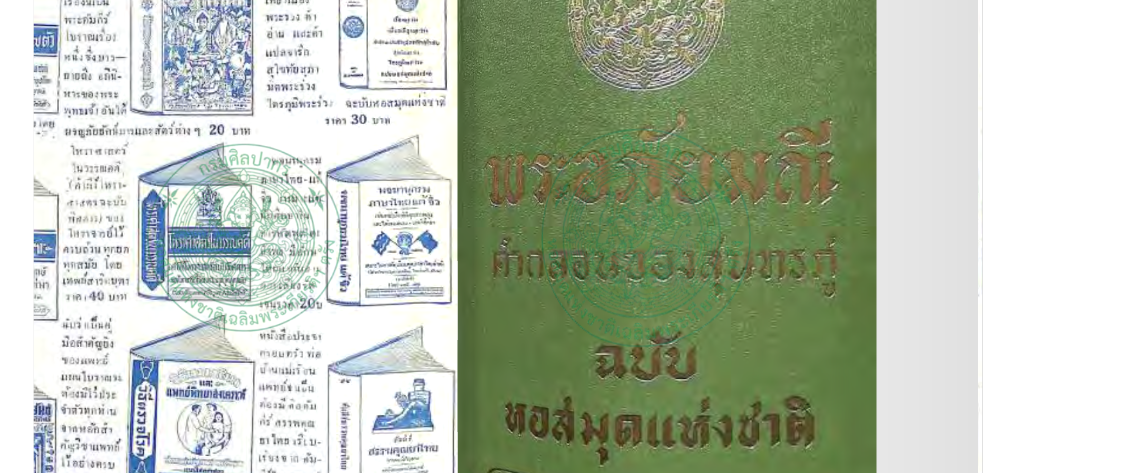
Phra Aphai Mani: The Epic Poem of Sunthorn Phu | พระอภัยมณี คำกลอนของสุนทรภู่
| Total Views | 9 Views |
|---|---|
| Author | Sunthorn Phu (สุนทรภู่) |
| Publisher | ศิลปาบรรณาคาร (Silapa Bannakhan) (1964) |
| Categories | Literature |
| Languages | Thai |
| File Size | 42.33 MB |
| Source / Credit | View Original |
Description
Phra Aphai Mani (พระอภัยมณี) is one of the greatest works of classical Thai literature, written by the celebrated Thai poet Sunthorn Phu (สุนทรภู่). Sunthorn Phu was born on 26 June 1786 and is regarded as one of Thailand's most important literary figures. His literary works are particularly renowned for their poetic language, imagination, memorable characters, and adventurous storytelling. The story follows Prince Phra Aphai Mani and his younger brother Sri Suwan, who leave their kingdom to study different arts. Phra Aphai Mani becomes famous for his magical flute, whose music possesses extraordinary power. His adventures take him across kingdoms, islands, oceans, and enchanted lands and bring him into contact with giants, hermits, mermaids, warriors, kings, pirates, and supernatural beings. One of the most famous episodes concerns the giantess Nang Phisuea Samut, who takes Phra Aphai Mani away after hearing the sound of his flute. They have a son named Sinsamut. Phra Aphai Mani eventually escapes with the help of a mermaid and reaches Ko Kaeo Phitsadan, where he meets a hermit. The adventures then continue through numerous kingdoms and mysterious islands. The epic also tells the stories of Suwannamali, Usaren, Sri Suwan, Sinsamut, Sudsakorn, Nang Laweng Wanla, Sao Khon, and many other characters. Sudsakorn, one of the most beloved characters in the poem, undertakes his own adventures while searching for his father and encounters the magical horse Mani Mangkon and the hermit's magical staff. A major part of the epic revolves around conflicts between the kingdoms of Phluek, Lanka, Romchak, Karavek, and Wahulom. Political alliances, wars, love, deception, magic, family relationships, and supernatural events are woven together throughout the narrative. The story eventually moves toward reconciliation and peace. Phra Aphai Mani renounces worldly life and enters the monastic path at Khao Singkhut. Nang Suwannamali and Nang Laweng also enter religious life. The younger generation subsequently takes responsibility for the various kingdoms. Phra Aphai Mani is notable not only for its extraordinary adventure story but also for its rich depiction of Thai culture, traditional beliefs, geography, morality, relationships, warfare, and imagination. It remains one of the most important masterpieces of Sunthorn Phu and a landmark of Thai literary heritage. Sunthorn Phu (1786–1855) was a renowned Thai poet of the Rattanakosin period. He is particularly famous for his Nirat poetry and Phra Aphai Mani. His distinctive poetic style and ability to combine fantasy, adventure, romance, humor, and social observation have made his works enduring classics of Thai literature. This listing refers to the first edition of Phra Aphai Mani: The Epic Poem of Sunthorn Phu, published in B.E. 2507 (1964 C.E.) in Phra Nakhon by Silapa Bannakhan (ศิลปาบรรณาคาร).
No comments yet. Be the first to share your thoughts!